



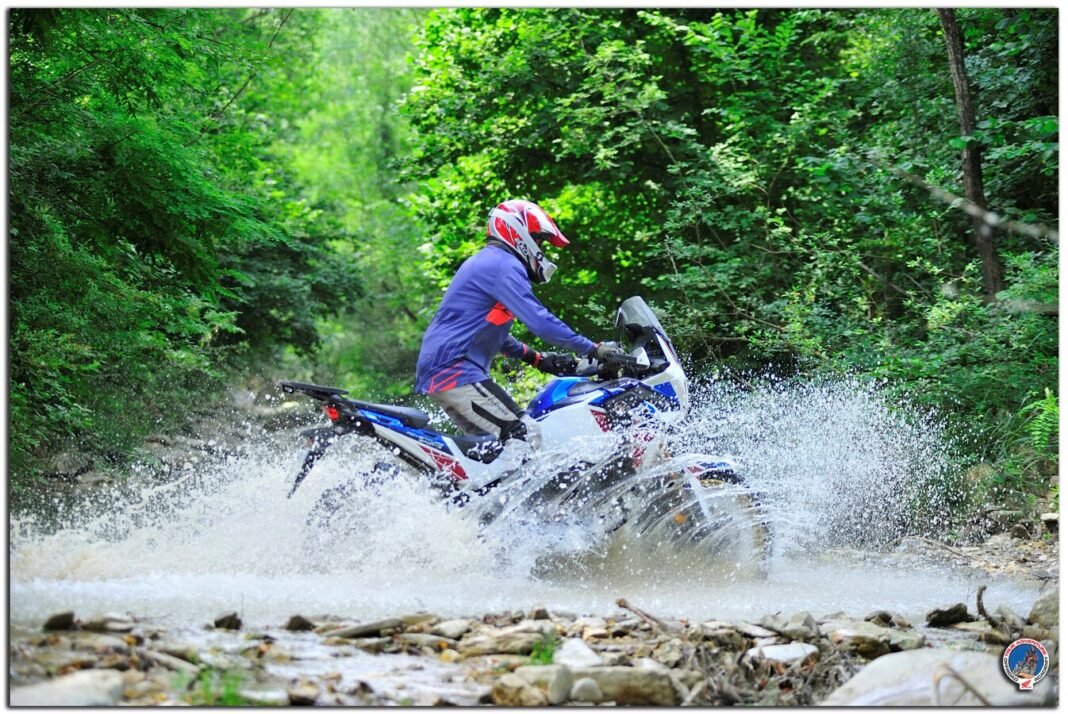

- Honda’s three official Adventure Centres – in Italy, France and the UK – offer owners a safe and controlled environment to explore the full potential of the flagship CRF1100L Africa Twin and other Honda models
- Riders can safely and comfortably build confidence with expert tuition allowing them to take on their own riding adventures across the globe
- The three major centres ensure amazing accessibility for a multitude of riders with a variety of base level skills
- Honda’s iconic CRF1100L Africa Twin is at the heart of all activity thanks to its formidable specification list and incomparable all-terrain ability
Honda has a long, storied history with off-road riding. Eight Dakar victories, from two generations (1981, 1986-1989, and 2020-21, and 2024) underpin its credentials when creating new adventure models, whilst top-flight motorsport also forms the basis of another unique Honda attribute: Its off-road training centres.
These centres present a special opportunity: the chance to be taught expert skills at centres led by from some of the very best riders in the world on a bike that is uniquely equipped to tackle any terrain on journeys of any length – the CRF1100L Africa Twin.
The adventure centres, and their owners may be separated by borders and several thousand miles, but they are all united by dirt, dust and a shared belief: adventure motorcycling, be it amateur or professional, isn’t about bravado, it’s about preparation. David Frétigné in Aveyron, France, Dave Thorpe in Exmoor, UK, and Marcello ‘Bulldozer’ Romano in San Giorgio Piacentino, Italy each run Honda-backed adventure and off-road centres shaped by elite racing careers, but defined today by teaching, empathy and progression.
A clear common theme across all three sites is that none of the owners set out to glorify their racing pasts. In fact, all three describe a moment of realisation: namely, that many riders need significant support and guidance to achieve the skills required to be prepared for genuine off-road riding. Frétigné, a multi-discipline champion (5x French Enduro Champion, 6x consecutive Trèfle Lozérien AMV winner, and Rally of Morocco champion 2008), recalls being surprised at just how many riders could benefit from learning the fundamentals needed to handle a big adventure bike once the tarmac ended. “I had all this accumulated knowledge – motocross, sand, rally raid,” he explains. “The centre became a way to share it properly, in real terrain, with real people.”
Three-time 500cc Motorcross World Champion (1985, 1986, 1989), Thorpe echoes that sentiment. After a lifetime with Honda and a storied racing career, he saw a gap between showroom dreams and real-world riding. “You can touch a bike in a dealership, but where can you actually ride it off-road?” he says. His answer was to work with Honda in the UK to build the centre, which offers a controlled, professional environment where customers could experience adventure bikes as they are meant to be used: guided, supported and safe.
Romano’s Italian academy follows a similar arc. While his background includes a successful racing stint, his focus today is firmly on progression rather than performance. His weekends blend theory, closed-course practice and then real public off-road routes, so skills are immediately contextualised. “They learn on Saturday,” he explains, “and on Sunday they understand how to use it in the real world.”
Despite their differing geographies, the centres share a strikingly similar philosophy: everything is tailored to the individual, and there is no ‘one size fits all’ template. Thorpe is particularly clear on this. Every rider arrives as a “blank piece of paper,” regardless of what they’ve written on the sign-on sheet. Instructors observe quietly at first – everything from body position, confidence, hesitation, before then adjusting the day accordingly. Nervous riders may be given additional one-to-one coaching, while more experienced participants are given space to progress without pressure. “We don’t want the fastest rider frustrated or the slowest rider pushed,” Thorpe says. “Free flow is the key.”
Frétigné has also refined this balance over time. Early on, his centre leaned heavily into racing intensity. Now, the emphasis is on success, not spectacle. “You need to show what’s possible,” he admits, “but you must never discourage people.” Riders need to leave having succeeded. That might mean deconstructing bad habits built over ten years, sometimes using video analysis so riders can see for themselves what needs correcting. “The smile at the end: that’s everything,” he says.
Romano’s approach is equally human-centred, with courses built around confidence-building rather than setting unrealistic targets. Riders may start at zero, but within two days many reach what he describes as 75% of their potential. From there, individual lessons and guided tours across Italy allow learning to continue organically. It’s not a one-off experience; it’s a pathway.
That idea of journey, rather than a single course, runs through all three centres. Bikes like the Africa Twin and Transalp are central to that journey, but none of the centres treat them as sacred objects. They are tools, chosen carefully to suit the rider. Thorpe champions smaller, less intimidating machines as stepping stones. “You don’t go from nothing straight to an Africa Twin,” he says plainly. “That’s a tough step.” Starting lighter builds confidence, and confidence unlocks progress.
This process sees an eclectic mixture of models from Honda’s range utilised, from the CRF300L, through lightly modified CL500s, the XL750 Transalp, to the CRF1100L Africa Twin. Catering for a diverse spectrum of abilities is key, and after introductions on the CRF300’s, the CL500 and Transalp serve as a crucial bridge, opening off-road riding to people who might otherwise never try. The Africa Twin, though, remains the emotional heart: its Dakar heritage has a unique resonance with riders dreaming of their own personal adventure. Romano is more direct still: “Africa Twin is more off-road. More beautiful. It’s a superb machine.”
Geography plays its part too. All three believe Europe offers something uniquely valuable: density and diversity of terrain. Mud, sand, rock, forest, mountains, sometimes within a single day. Frétigné speaks passionately about responsibility here, stressing respect for locals and nature as part of rider education. Learning skills is one thing; learning how to exist responsibly in those spaces is another.
There’s unity in what each of the three centres want riders to feel when they leave. Not speed. Not a feeling of dominance. Confidence, learning and enjoyment. Thorpe wants smiles first and reflection later; moments when riders realise how much more relaxed they felt at the end of the course, and how they benefit from working with other riders of similar ability. Romano wants emotion: the deeper connection that comes from discovering landscapes by motorcycle rather than by car or on foot. Frétigné wants knowledge, and a real, practical understanding that riders can carry anywhere in the world.
When asked what they’d say to someone considering off-road riding for the first time, there’s unanimity. Don’t self-teach. Don’t be intimidated. Go somewhere professional. Learn properly. “With the right tools, it’s easy,” Frétigné insists. “And it’s safer than people think.”
That supporting arm of encouragement is a universal feeling amongst the owners. There’s no ego, no rivalry – just three seasoned riders who’ve traded trophies for teaching. Their centres aren’t about creating racers, but about creating well-rounded motorcyclists: riders who want to understand their bikes, respect their limits, and who, ultimately, are equipped to chase their own adventures with confidence, wherever the road may take them.
-ENDS-
For more information on the three adventure centres, as well as course availability and pricing, please visit the following links:
FR – https://www.davidfretigne.com/
IT – https://www.trueadventureoffroadacademy.com/
UK – https://www.davethorpehonda.com/