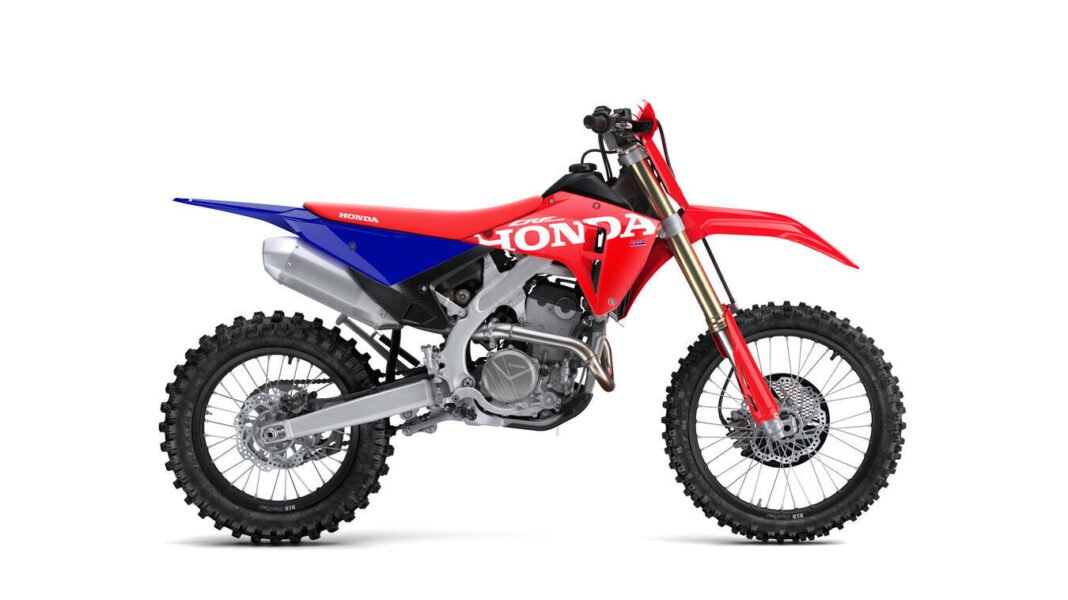




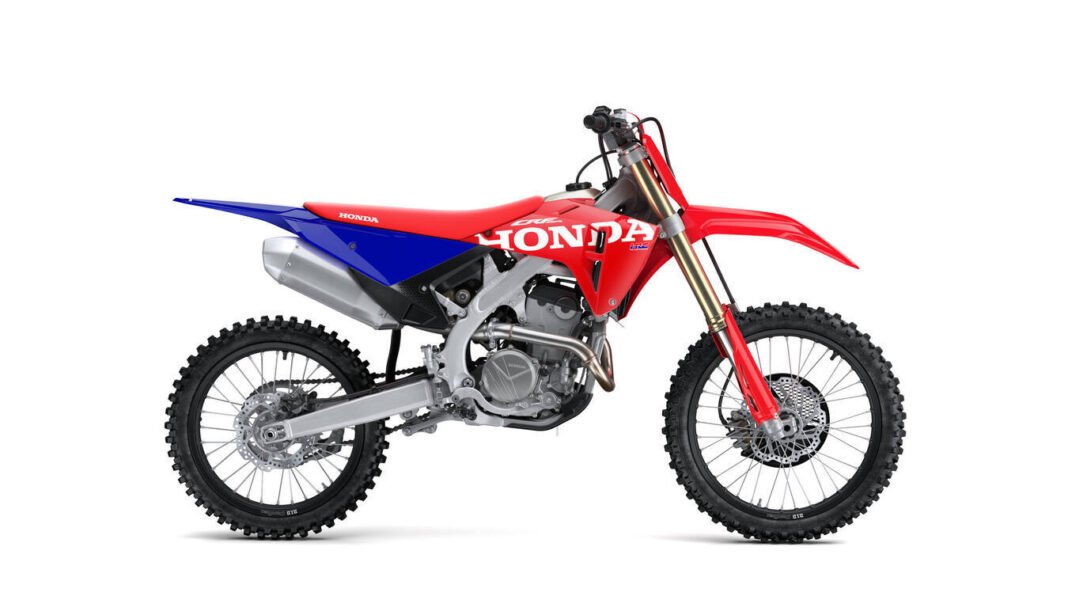

Model Update: A new colour and graphic set for 27YM, means the CRF250R rocks into the new year in style following its major 25YM overhaul. Improved cornering stability especially on rough circuit conditions – with zero loss of steering agility – was the outcome of a comprehensive re-engineering of the CRF250R for 25YM. A 70% new mainframe, alongside a variety of cycle part updates plus completely new Showa suspension and a two-piston Nissin front brake caliper were the main changes driving the performance upgrade. The 25YM-spec engine featured a revised crankshaft, enhanced throttle connection, mid-range torque feel, and power past peak via revised intake/exhaust and PGM-FI settings. Electronic specification for 25YM included new 3-level Honda Selectable Torque Control (HSTC) in addition to Launch Control and Engine Mode Select Button (EMSB). New plastics and updated CRF family graphics treatment signified the model.
27YM will also see the CRF250RWE become the CRF250R HRC-WE, retaining the bespoke parts that further enhance the bike’s performance and appeal.
–
Contents:
- Introduction
- Model overview
- Key features
- Technical specifications
–
1. Introduction
The MX2 class is a relentless, close-quarter battle. And Honda’s CRF250R has proved itself a worthy weapon for the fight. Competition has led its evolution over time, through increments and steps, into a platform that the amateur MX enthusiast – as well as the pro-racer – can extract the utmost out of, every metre of every lap.
And it’s been on a massive development journey. In 18YM the CRF250R underwent a ground-up redesign that inherited the direction of the 17YM CRF450R, sharing its seventh-generation frame, revised geometry and Showa suspension. It was also armed with a brand-new DOHC engine and switchable engine mapping; rider-focused ergonomics ensured it remained an MX machine that the hobby rider could exploit to their individual level of ability.
The 19YM CRF250R received a boost to low-rpm torque, through extensive intake and exhaust development plus HRC launch control, revised front brake caliper and adjustable-position Renthal Fatbars. In 20YM it moved forward once again, with the frame and swingarm of the 19YM CRF450R and more mid-range for the engine.
For 22YM it made a significant performance with major chassis upgrades inherited from the 21YM CRF450R, improving both ability and agility. It also received stronger low-rpm torque to make best use of the new chassis, with improved toughness and durability.
25YM saw major changes for the CRF250R, just like the 25YM CRF450R, with a brand-new chassis, revised suspension, a harder hitting engine, and restyled fairings to give riders that competitive edge.
Now, for 27YM, revised graphical options refresh the CRF’s look and unify Honda’s off-road competition derived machines with its circuit racers under the HRC banner.
–
2. Model Overview
Enhanced stability and control, especially over the roughest track conditions, were goals for the 25YM CRF250R. The aluminium twin-spar frame was 70% new, with a completely revised rigidity balance alongside new subframe attachment points, top/bottom yokes and stem, front wheel axle/clamp and Pro-Link ratio.
The Showa suspension was completely remade with 250-specific settings, to deliver consistent damping and suspension reaction from bottom to top of the stroke. Both 49mm front forks and the rear monoshock gained new settings; the rear shock was also made much easier to remove. HRC provided the blueprint for the new front brake caliper, which now features machining for the body, plus revised pistons and seal grooves to resist heat fade over race distance.
For enhanced throttle control, drive and sustaining power past peak output, the DOHC 4V engine employs a straighter path for airflow on the intake side, a straighter exhaust pipe route and revised PGM-FI settings. The muffler meets new FIM noise regulations.
Crisply designed side covers and radiator shrouds are emphasised through all-new CRF family graphics, which mark out the 27YM CRF250R.
–
3. Key Features
3.1 Chassis
- Aluminium twin-spar frame improves overall stability
- Showa front/rear suspension delivers smooth, consistent damping control
- Pro-Link shock linkage structure and ratio
- HRC-design front brake caliper resists heat fade
The 25YM CRF250R – well established as a fast-steering, lightweight tool – shares the exact same chassis as the 25YM CRF450R to push handling ability further, thanks to increased straight line and cornering stability, bump absorption, and feel for front and rear grip.
The twin-spar aluminium main frame was a 70% redesign, developed with the aim of enhanced overall chassis stability on the roughest of track conditions. A revised front down tube, stiffener spars and side gusset stiffener were combined with new pivot plates, upper shock mount and tension bracket to generate 8% more torsional rigidity – improving stability. The torsional/lateral rigidity ratio was also made 5% greater, elevating cornering performance.
Vertical torsional rigidity was increased 4%, to help suppress deformation and enhance high-speed stability; facilitated by the rear subframe now mounting on the high-rigidity pivot plates (rather than the frame spars). This change reduced the transmission of energy (and subsequent movement) from the back of the machine to the rear head pipe section by 27%.
A great deal of work went into the top/bottom yoke and steering stem to achieve a more consistent and stable suspension stroke. Alongside revised fork outer tubes and new front axle bolt the 25YM setup proved to be more rigid, equalling a reduction of 6% in rigidity change during the stroke. The 585.2mm aluminium swingarm is unchanged.
Rake and trail are set at 28°24’/117mm with 1,483mm wheelbase and 330mm ground clearance. Dry weight is 102kg (107kg wet) with a 48.6/51.4% front/rear balance (wet).
The Showa 49mm USD coil spring forks were effectively brand new for 25YM with each component part – from outer rigidity to all internals – remade to deliver enhanced control from the initial movement all the way through the 310mm stroke. There are 16 adjustment positions for both of rebound and compression; all settings were revised for 25YM.
Matching the forks, the Showa rear shock was remade to deliver consistent, uniform control anywhere in the stroke, with friction reduced in the bottom. There are 17 adjustment positions for rebound and 3.5 turns for high and 13 adjustment positions for low-speed compression, all revised for 25YM. As was the Pro-Link structure, now 11% more rigid, with ratio and axle travel optimised to deliver smoother bump control. Axle travel is 308mm
The 25YM CRF250R was also designed to make shock removal/replacement quicker, with only four parts needing removal, cutting time to change in half.
Drawing from parts employed by HRC’s factory race bikes, the 25YM machines received re-machined, two piston front brake caliper that use revised pistons and piston seal grooves. The design reduces lever play by 57% when caliper temperature is high, while the caliper itself reduces rigidity change when hot by 25%, improving brake lever linearity and reducing rider fatigue. The 260mm wave-pattern disc is unchanged; a single-piston rear caliper is matched to a 240mm wave-pattern disc.
DID aluminium rims, with directly attached spoke pattern layout are finished in black; the front is a 21 x 1.6in, the rear a 19 x 1.85in. Pirelli’s MX32 tyres are fitted as standard equipment, sized 80/100-21 front and 100/90-19.
Minimal bodywork aids rider movement around the machine. The shrouds and side covers were updated for 25YM, using a consistent CRF design philosophy focussed around weight reduction, mass centralisation and rider-friendly ergonomics. A flat knee trajectory, front to back of the machine, has been maintained.
All the 27YM CRF250 and 450 family members feature new family graphics that bring together Honda Racing’s activities, both on- and off-road, under one visual identity. The titanium fuel tank holds 6.3L.
Standard-fit, lightweight Renthal Fatbar flex for optimal comfort; the top yoke features two handlebar-holder locations for moving the handlebar rearward and forward by 26mm. When the holder is turned 180°, the handlebar can be moved an additional 10mm from the base position, resulting in four unique riding positions.
–
3.2 Engine
- Direct airflow intake route improves throttle connection and torque feel
- Exhaust downpipe design boosts mid- to top-end acceleration range
- New crankshaft is more rigid around crank pin with improved moment of inertia
- Power UP past peak output
The CRF250R’s 249.4cc 4V DOHC engine has long established a top-end that’s one of the best on track, but it also builds torque and power from low rpm. For 25YM, development focused on sustaining power beyond peak rpm, increasing mid‑ to high‑rpm torque to minimise performance drop‑off, while improving acceleration and throttle connection.
A newly redesigned crankshaft features increased rigidity around the crank pin and an improvement in the moment of inertia, allowing it to spin up faster. In conjunction the airflow route – through intake, airbox, intake funnel and throttle body – is more direct than the previous design, reducing resistance and improving throttle control.
A redesigned exhaust pipe also uses a straighter, smoother path for gas flow than the previous model which improves acceleration in the mid- to high-rpm range. The muffler is constructed from heat-treated aluminium to better stand up to the rider’s boot; it meets the new FIM 109dB noise regulation.
The intake cam sprocket is press-fit, saving weight and increasing rigidity. Double springs for the intake valves give extra high-rpm control. The oil’s pathway to the camshaft journals – and a rigid camshaft holder and head – reduce journal friction.
Precise alignment of the rocker arm shaft position aids high-rpm performance while the piston and connecting rod design maximise efficiency. Bore and stroke are set at 79 x 50.9mm, with a 4.5mm cylinder offset to reduce friction and compression ratio of 13.9:1. The valves are titanium; 33mm inlet and 26mm exhaust.
Extra levels of reliability are built in. The water pump gear design deals efficiently with high-temperature oil while pressure to the cylinder head ensures greater oil flow. A 5-hole piston oil jet maintains optimum piston cooling and ignition timing.
The combined oil pump/drive gear is on the right-hand side of the engine, with the oil filter and oil way on the right side – the oil’s path around the engine is short and straightforward and the oil also lubricates the clutch and transmission, with a total oil capacity of 1.25L.
–
3.3 Electronics
- Equipped with Honda Selectable Torque Control (HSTC) featuring 3 riding Modes (plus OFF)
- 3-Mode HRC Launch Control
- Engine Mode Select Button (EMSB)
- HRC Setting tool tailors Aggressive and Smooth modes
The HSTC – as fitted to the CRF450R – works to minimise rear wheel spin (thus reducing wasted forward drive) and maximise traction. It doesn’t use a wheel speed sensor, and critically maintains feel at the throttle while managing power; ignition timing is retarded, and the PGM-FI controlled when the rate of change of rpm is detected to have gone over a set amount.
Three Modes differ in drive management level for different riding conditions:
- Mode 1 intervenes most lightly, and after the longest time – useful for reducing wheelspin
- Mode 2 naturally offers a mid-point between 1 and 3 in terms of speed and strength of intervention and maintaining control in tight corners.
- Mode 3 has the system intervene more quickly and strongly, and is therefore useful in more slippery, muddy conditions.
HSTC can also be switched off completely. When the engine is turned on, the system uses the last-selected setting.
The Launch Control also has 3 Modes: Mode 1 has a high rev limit, 2 (the factory setting) uses a middle point with 3 set low. There are 3 Modes available via the Engine Mode Select Button (EMSB) to alter engine character. Mode 1 is the factory setting, 2 smooth and 3 aggressive.
The Launch Control indicator, EFI warning, HSTC and EMSB mode button, and LED indicator are sited on the left handlebar. Pressing and holding the HSTC button for 0.5s will cycle the system to the next mode, with a green LED indication – 1 blink for Mode 1, 2 for Mode 2 and 3 for Mode 3 – to confirm selection.
–
CRF250R HRC WORKS EDITION
For 27YM, the CRF250RWE is rebranded as the CRF250R HRC Works Edition to align with its larger 450 stablemate. Benefitting from all the model upgrades of the CRF250R, the CRF250R HRC-WE features additional parts that enhance both its performance and its appeal.
Built alongside the CRF250R in Kumamoto, the CRF250R HRC-WE features a Yoshimura muffler and TwinAir air filter to improve air flow management. Exclusive ignition timings and unique start mode settings, alongside a hydraulic clutch to help the rider. The CRF250R HRC-WE model features a hydraulic clutch system that reduces clutch lever pulling force by 16% when compared to a cable operated system. It also reduces the amount of variation in clutch free play and feel as the clutch temperature increases.
The intake/exhaust ports of HRC-WE cylinder head are hand-finished by specialist craftspeople in the Kumamoto factory to remove any small steps in the port created in the casting process. This makes air flow smoother and improves power delivery. The laser engraving “CRF WORKS EDITION” is added to the cylinder head to underline its special status.
The rear shock features a titanium coated rod for improved wear resistance and rear wheel control, paired to upgraded front forks, which now feature a special dark Kashima coating on the outer tube and a titanium coating on the slide pipe for optimal wear resistance.
The CRF250R HRC-WE also features a striking metallic red engine head cover, black top and bottom bridges, a gold DID DM2 chain, Renthal bar grips, a Throttle Jockey seat, black DID-LTX wheel rims, a black anodised front axle holder as well as updated graphics and laser engraving on the wheel rims and suspension caps. The hand-operated compression adjuster knob on the top of the front suspension provides easier adjustment without the need for any tools.
–
4. Technical Specifications
|
ENGINE
|
|
|
Type
|
Liquid-cooled 4-stroke single cylinder DOHC
|
|
Displacement
|
249.4cc
|
|
Bore & Stroke
|
79mm x 50.9mm
|
|
Compression Ratio
|
13.9:1
|
|
Oil Capacity
|
1.25L
|
|
FUEL SYSTEM
|
|
|
Carburation
|
Fuel injection
|
|
Fuel Tank Capacity
|
6.3L
|
|
ELECTRICAL SYSTEM
|
|
|
Starter
|
Electric
|
|
DRIVETRAIN
|
|
|
Clutch Type
|
Wet multiplate
|
|
Transmission Type
|
Constant mesh
|
|
Final Drive
|
Chain
|
|
FRAME
|
|
|
Type
|
Aluminium twin tube
|
|
CHASSIS
|
|
|
Dimensions (L´W´H)
|
2,179 x 827 x 1,262mm
|
|
Wheelbase
|
1,483mm
|
|
Caster Angle
|
28°24’
|
|
Trail
|
117mm
|
|
Seat Height
|
955mm
|
|
Ground Clearance
|
330mm
|
|
Kerb Weight
|
102kg (CRF250RWE 103kg)
|
|
SUSPENSION
|
|
|
Type Front
|
49mm Showa (Hitachi Astemo, Ltd) coil-spring USD fork
|
|
Type Rear
|
Showa (Hitachi Astemo, Ltd.) Mono shock with Honda Pro-Link
|
|
WHEELS
|
|
|
Type Front
|
21 x 1.6in Aluminium spoke nipple
|
|
Type Rear
|
19 x 1.85 Aluminium spoke nipple(CRF250R)
19 x 2.15in Aluminium spoke nipple(CRF250RWE)
|
|
Tyres Front
|
80/100-21 PIRELLI MX32 MIDSOFT(CRF250R)
80/100-21 Dunlop MX33F (CRF250RWE)
|
|
Tyres Rear
|
100/90-19 PIRELLI MX32 MIDSOFT(CRF250R)
110/90-19 Dunlop MX33 (CRF250RWE)
|
|
BRAKES
|
|
|
Front
|
260mm hydraulic wave disc
|
|
Rear
|
240mm hydraulic wave disc
|
All specifications are provisional and subject to change without notice.
# Please note that the figures provided are results obtained by Honda under standardised testing conditions prescribed by WMTC. Tests are conducted on a rolling road using a standard version of the vehicle with only one rider and no additional optional equipment. Actual fuel consumption may vary depending on how you ride, how you maintain your vehicle, weather, road conditions, tire pressure, installation of accessories, cargo, rider and passenger weight, and other factors.
-ENDS-