





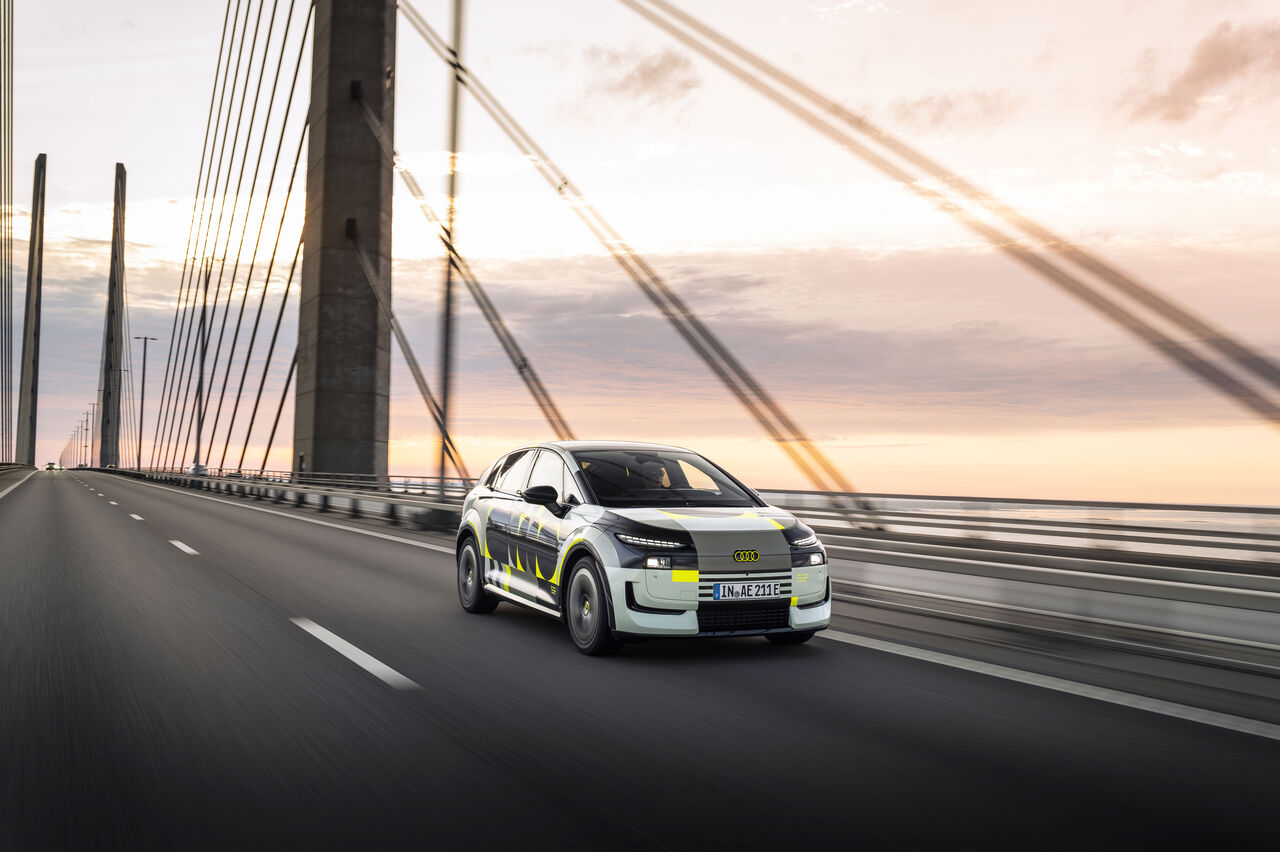
For the battery in the A2 e-tron 140 kW, Audi uses lithium iron phosphate (LFP) cells in a cell-to-pack design: the cells are bonded directly into the housing, which increases packing density. This means the energy content and energy density of the high-voltage system can be increased while taking up less space. The LFP battery does not require rare earth elements, ages more slowly than many alternatives, and is considered particularly safe. Thanks to this durability, the batteries can be routinely charged to 100 percent in everyday use. This consistently enables long range.
Thanks to its characteristically flat voltage curve, the battery maintains a high voltage even as the state of charge (SoC) drops, delivering more consistent power output. This is important for the overall picture. After all, efficiency is not just about reducing energy consumption — it also means ensuring the battery maintains its performance and usability over a long service life. LFP technology offers greater aging stability, making it an excellent choice for everyday electric mobility.
But the cell chemistry of the LFP battery is just one element. The greatest efficiency gains emerge from the precise interplay of battery, thermal management, charging electronics, and software. For example, an adapted cooling strategy increases wallbox charging efficiency to 89.6 percent, which means less energy lost and more consistent charging behavior day to day.
Overall, the Audi A2 e-tron demonstrates that efficiency in an electric vehicle isn’t merely a matter of hardware — it depends to a great extent on the control strategy. An algorithm specifically turned to the LFP battery accurately assesses its state of charge and state of health.
The A2 e-tron also supports bidirectional charging: Vehicle-to-Load1 powers external devices directly from the car, while Vehicle-to-Home2 allows the vehicle to be used as a home energy storage system. An Audi-recommended charging box is required.