




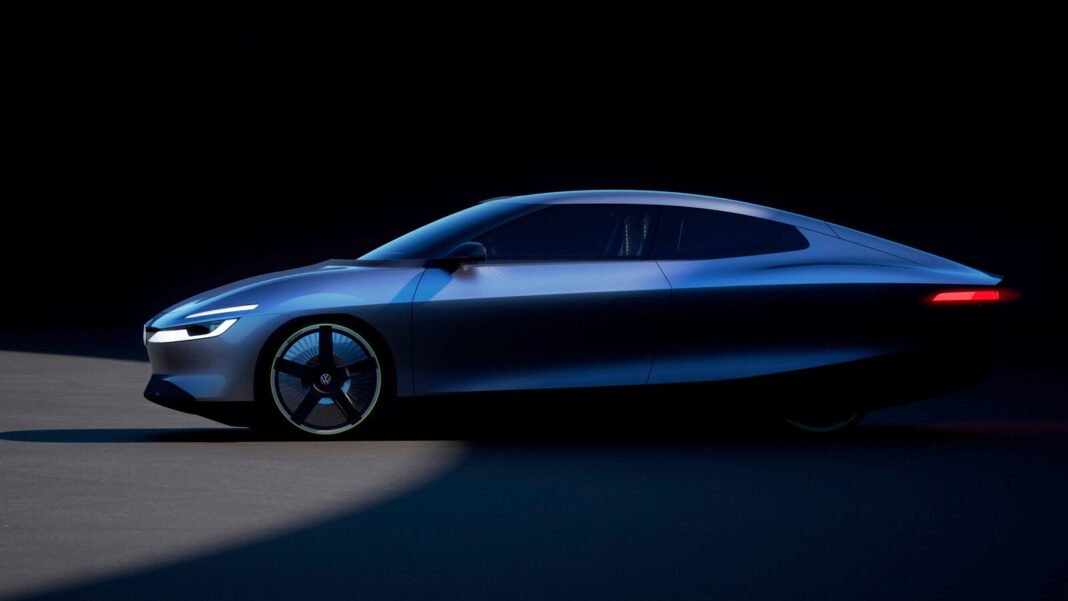
Aerodynamics-inspired form that reduces consumption. The ground-breaking low air resistance, achieved as a result of the drag coefficient (Cd = 0.158) and small frontal area (A = 2.08 m²), is the Mission Efficiency’s central aerodynamic feature. It consists of a flow-optimised teardrop shape, small frontal area, active cooling air flaps, clad rear wheels and a fully clad underbody. The doors to the Mission Efficiency feature frameless windows, while the door handles have been integrated into the outer skin for optimum air flow. The overall concept pays off, especially at higher speeds: from speeds above 80 km/h, consumption is more than 30 per cent lower than in the standard version of the ID. Polo. At 140 km/h, the Mission Efficiency requires about as much energy as the ID. Polo at 100 km/h.
Andreas Mindt, Chief Designer at Volkswagen: “With its front end, the Mission Efficiency slots into our new family of electric vehicles, which also includes the ID. Polo and ID. Cross. The shape of the body itself is committed fully to functionality and thus the laws of aerodynamics. This has resulted in a state-of-the-art, efficient sports car in which the DNA of the legendary Volkswagen XL1 shines through.” Presented in 2013 and fitted with a plug-in hybrid drive, the XL1 was the most economical production car in the world at that time.
At 4,775 mm long and 1,392 mm tall, the Mission Efficiency coupé offers 2+2 seats and 481 litres of capacity in the luggage compartment. Additional stowage compartments under the rear seats and in the sides of the body create space for everyday items and the charging cable. While the front interior can be used without restriction, the two rear seats are intended for passengers up to a height of approximately 1.60 m. The prototype was designed so that it could theoretically be used by a young family of four. The body combines components of the ID. Polo with a self-supporting aluminium structure and components made of a high-strength carbon fibre-reinforced polymer (CFRP) and aramid composite.

